The Demographic Reset: Unlocking Real Growth With Adults 25–64
For years, 25-54 has been the industry’s comfort zone. It became the standard in the early 2000s and for a long stretch it aligned with where careers, families, and spending power intersected. But adulthood has changed, and the economic timeline has stretched. And if we’re honest about where growth lives today, the traditional frame is too narrow.
Adulthood Has Stretched and So Has Spending Power
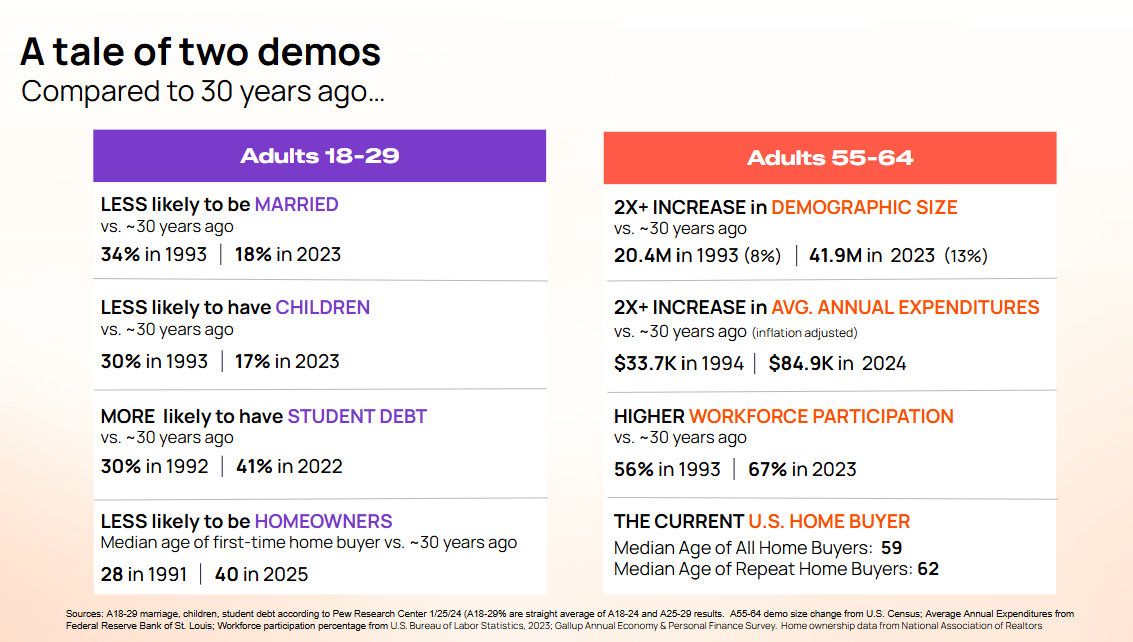
Younger adults are reaching major milestones later. The median age of a first time home buyer has climbed from 28 in the early 1990s to 40 today.¹ Marriage and children happen later. Student debt is higher. Housing costs have increased nearly 290% since the mid 1990s and tuition has risen more than 250%.² The early adult years look very different than they once did.
At the same time, older adults are staying economically active longer. Labor force participation among adults 55-64 has risen from 56% in the early 1990s to 67% today. Expected retirement age now sits at 66.³ Longer lifespans and financial responsibility mean that earning years extend further than they did a generation ago.
When people say “60 is the new 40,” it captures something real about longevity, health, and economic contribution.
The Economic Center of Gravity Is 55-64 & Gen X
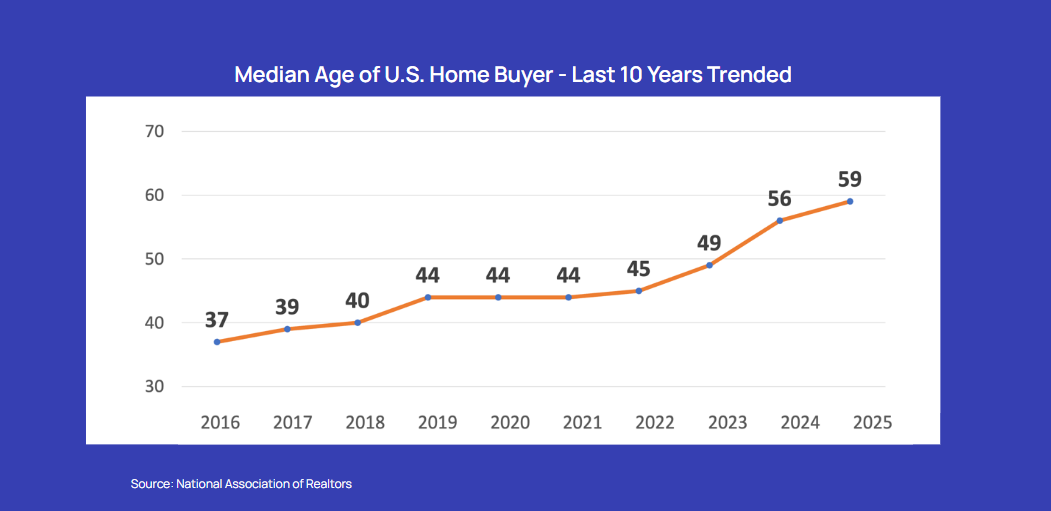
Adults 55-64 make up 17.8% of US households, yet they punch above their weight economically, driving nearly 20% of both income and spending.⁴ Their median net worth of $364,500 is significantly higher than younger segments.⁵ The median age of the US home buyer is 59,¹ and annual spending in this group has more than doubled over the past three decades.⁴
This is not a declining segment. It is a financially dominant one.
And culturally, this group is not who many marketers assume they are. 70% of adults 55-64 are Gen X, not Boomers. They came of age alongside hip hop and the internet. They were early adopters of digital platforms and have evolved with technology, not around it.
Digital Engagement Is Accelerating
Monthly YouTube viewing among adults 55-64 is up 25%, Smart TV viewing has climbed 61%, and daily podcast listening has surged 173%, making this one of the fastest-growing digital audiences.⁷
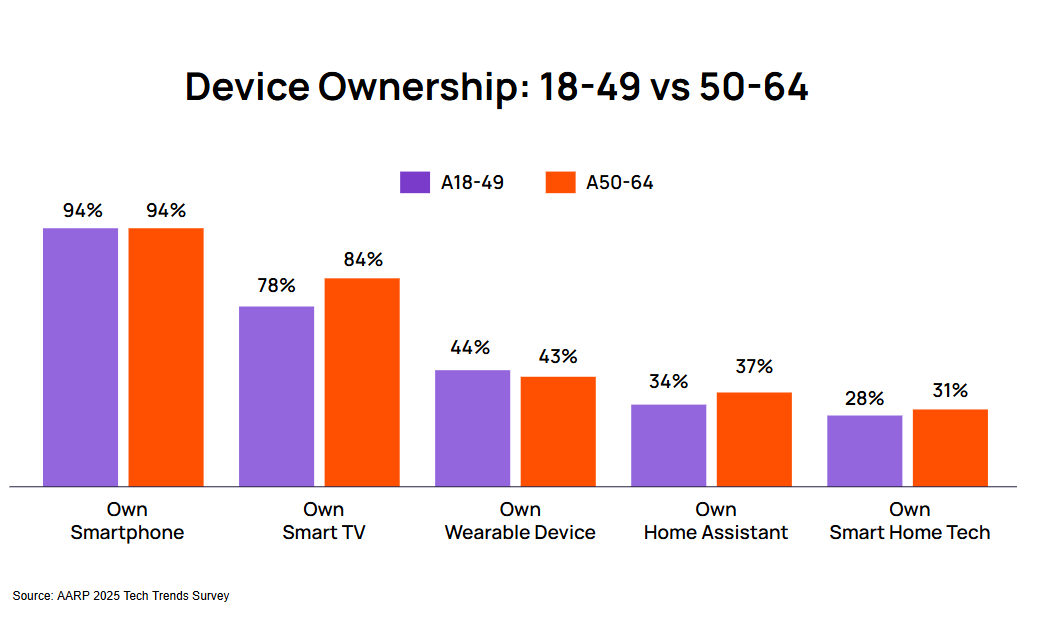
Ownership data tells the same story. Smartphone adoption among 50-64 is at full parity with 18-49, and wearable ownership is essentially identical.⁸ In fact, in several categories, they actually lead, with higher ownership of Smart TVs, home assistants, and smart home technology.⁸ These aren’t marginal differences; they reflect deeply connected households that are actively using streaming platforms, voice-enabled devices, and integrated home systems as part of their everyday lives.
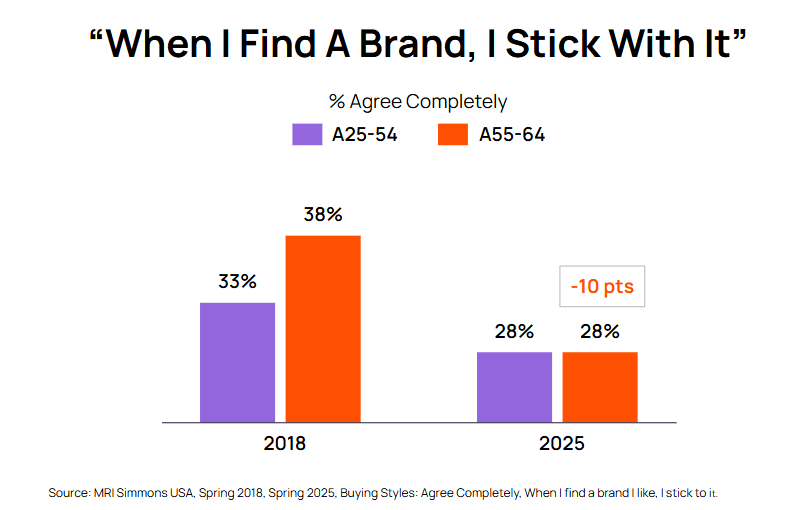
Even brand behavior signals opportunity. The share of adults 55-64 who say they completely agree that they always stick with a brand has declined over time.⁹ Openness to trying new brands is increasing. That combination of wealth and flexibility is powerful.
Expanding the Demo Expands the Business
When you move from Adults 25-54 to Adults 25-64, you expand the national radio audience from 107 million to 140 million adults.¹⁰ That’s a 31% increase in reach. You’re adding 33 million adults to your addressable radio audience simply by aligning your target with how adulthood actually looks today.
What’s critical is that you don’t sacrifice quality when you expand. You gain 31% more reach, but the audience profile holds steady. Higher-income households remain just as concentrated, and homeownership actually increases in the broader group. Real-world behavior shows spending patterns across categories like auto, travel, home improvement, dining, and tech don’t drop off. The economic profile stays strong.
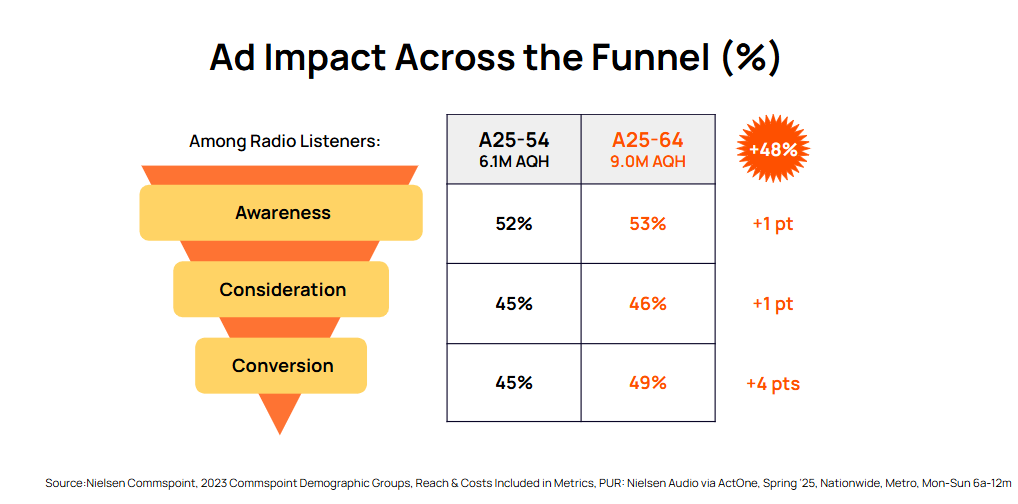
When we look at advertising performance, the broader 25-64 audience delivers increases in awareness and consideration, along with a four-point lift in conversion among exposed listeners.¹² 4% at scale represents real incremental sales. More purchases. More bookings. More measurable business outcomes.
“Conversion is where business impact becomes tangible,” said Ray Borelli, SVP of Research and Insights at Audacy. “A 4% lift at scale translates into measurable revenue, not just awareness.”
Brands Are Already Following the Money
DoorDash: Fastest growth among adults 55-64, with unique visitors in that segment up 70% year over year.¹³
Delta: The 55-64 segment represents its largest share of premium seat customers, indexing well above average.
Subaru: Forester ownership and purchase intent skew toward consumers in their late 50s, helping drive continued strong performance.
Hoka: Median purchaser age is 52, and the brand has scaled into a $5 billion business.
L’Oréal: 34% of US women 55-64 are consumers, and the company has publicly identified this group as a key growth driver.¹¹

These brands aren’t chasing older consumers out of sentiment. They’re aligning with where purchasing power and responsiveness intersect.
Growth Lives Where Reality Lives
The advertisers’ shift from 18-49 to 25-54 happened more than two decades ago. Since then, careers have lengthened, wealth has accumulated later, and digital behavior has flattened across generations.
Expanding to 25-64 is not about abandoning younger adults. It’s about reflecting how adulthood and spending power actually work today. It’s about capturing 31% more people without lowering income quality. It is about unlocking 48% more listening.¹⁰ It is about gaining a 4% lift in conversion.¹²
If the goal is to move your business, the opportunity is clear. The demographic reset is not theoretical. It’s already visible in who is buying homes, booking travel, ordering delivery, purchasing premium seats, and responding to advertising.
Want to talk more about reaching your target audience?
Let´s Talk- National Association of Realtors; median age of first-time and overall home buyers
- Federal Reserve Bank of St. Louis; housing price index and tuition inflation since mid-1990s
- U.S. Bureau of Labor Statistics; Gallup Annual Economy & Personal Finance Survey
- U.S. Bureau of Labor Statistics; MRI-Simmons USA Summer 2025
- Federal Reserve Survey of Consumer Finances, 2023
- U.S. Census Bureau single-year age projections
- Ampere Analysis; Edison Research Share of Ear
- AARP 2025 Tech Trends Survey
- MRI-Simmons USA Spring 2018 vs Spring 2025 Buying Styles Study
- Nielsen Audio Spring 2025; ActOne Nationwide Metro; population estimates
- MRI-Simmons USA Summer 2025
- Nielsen Commspoint 2023; Nielsen Audio Reach & Costs Metrics
- Comscore Multi-Platform Unique Visitors, October 2025 vs October 2024
Related Insights
Related Insights
Ready to Make Audio Work for Your Brand?
ADVERTISE WITH US