The Commuter Election: Why America's Rush-Hour Voter Will Decide the 2026 Midterms
New Audacy research shows the 2026 midterms are becoming a single issue election; and commuters may decide the outcome.
To borrow a phrase from political strategist James Carville, “It’s the economy commuter, stupid.”
For millions of working Americans, the cost of living crisis isn’t an abstract policy debate. It’s an everyday reality bracketed by financial anxiety — starting with high gas prices during the morning commute and ending with soaring grocery bills at night.
Audacy recently commissioned a wide-ranging study of 1,000 registered U.S. voters with YouGov and found that while economic pressures are deeply impacting virtually everyone, it’s commuters who are feeling the burn the most.
It’s because commuting amplifies the cost-of-living crisis. Grappling with gas, car insurance, housing and utility costs that have skyrocketed by more than 40%, commuters feel the squeeze more and are cutting discretionary spending faster than their peers. And as they watch their paychecks shrink, the psychological toll of working hard yet falling behind has left them angry and exhausted.
With the midterm elections looming, the state of the economy isn’t just another issue on the ballot for commuters — it’s a political reckoning. They are at their breaking point, making them highly motivated to show up at the polls and vote for change.
They may very well hold the keys to power this November.
Voters are Sending a Clear Message: Fix the Economy or Pack Your Bags
A wall of economic resentment is sweeping the country as the majority of Americans categorize the U.S. economy in one word: bad. Three-quarters of the population feel poorer than they did a year ago, while 70% report that relentless gas prices have forced a direct downgrade in their lifestyle. Rather than seeing light at the end of the tunnel, voters overwhelmingly expect conditions to decay further.
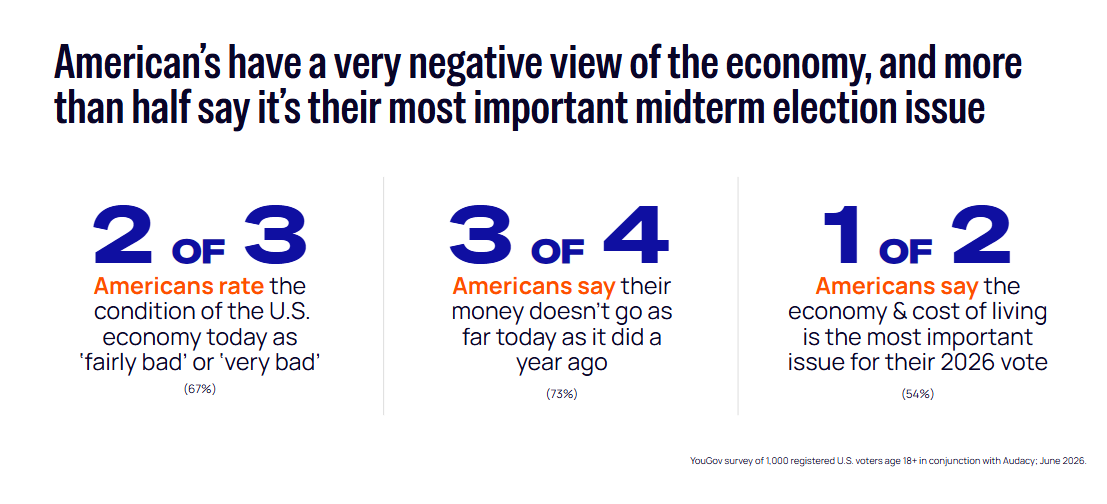
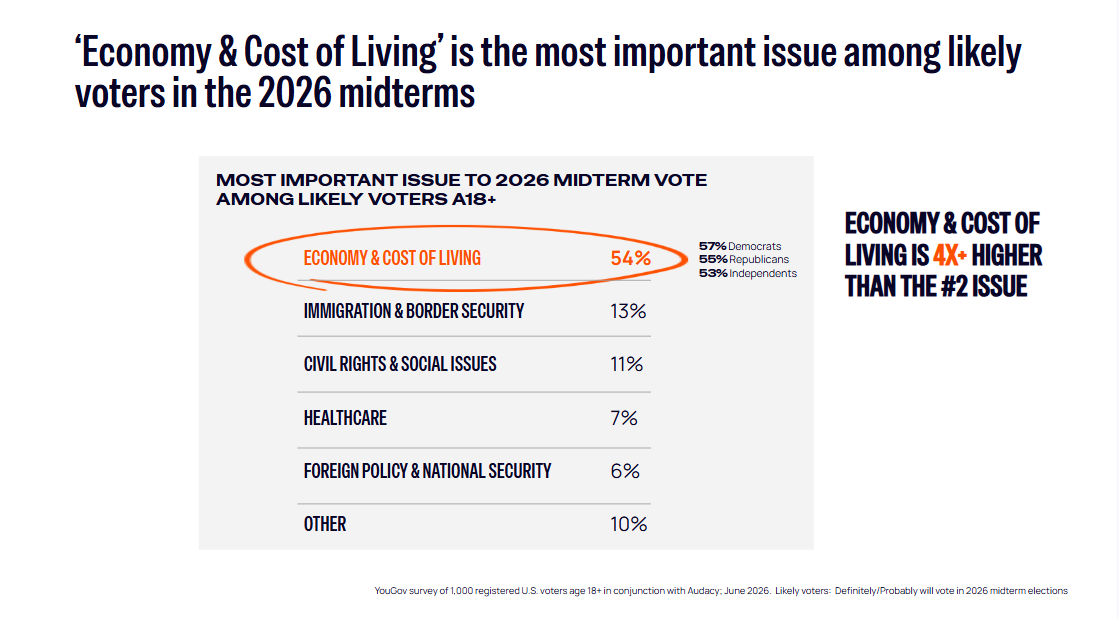
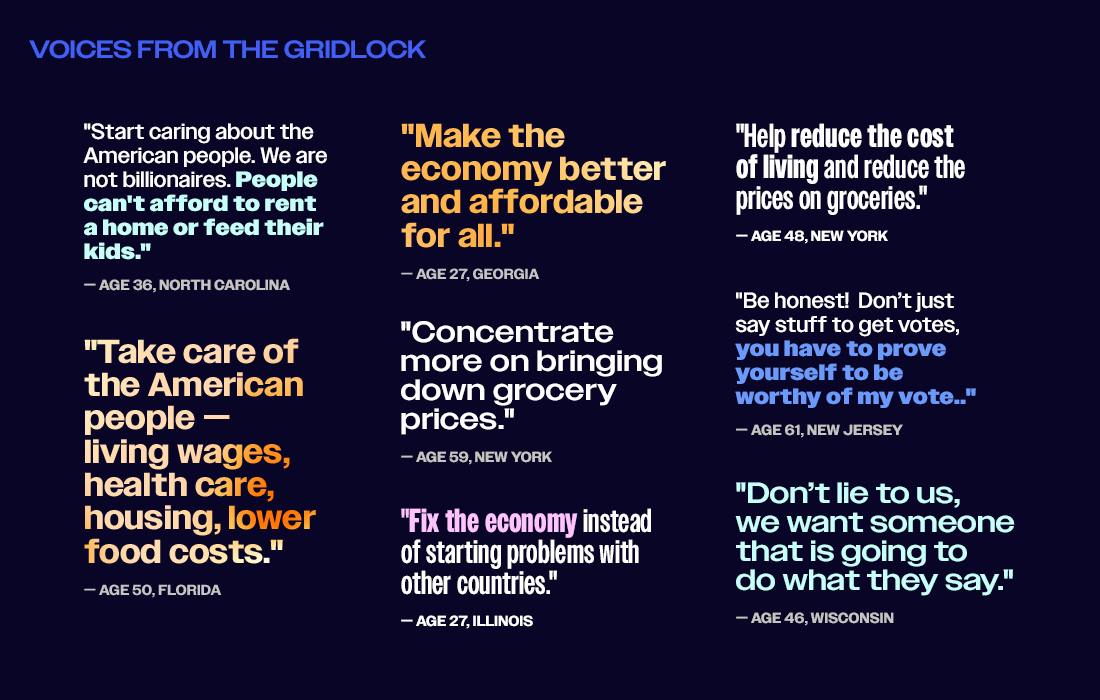
There is no doubt that the economy will be the #1 issue on the minds of Americans when they head to the polls this November. More than half of all likely voters identify the cost of living as the single most important issue shaping their vote — a remarkable point of consensus across Democrats, Republicans, and Independents alike. We found that it outpaced the second-ranked issue by an extraordinary four-to-one margin, underscoring that economic concerns are not simply leading the political agenda — they are overwhelmingly defining it. For many voters, the pressures of making ends meet have eclipsed nearly every other political debate.
The 2026 Midterm Pressure Point: The Rush-Hour Voter
Economic anxiety is hitting hardest on the highway.
Commuters are even more likely than registered voters overall to say the economy will be the most important issue driving their vote in the 2026 midterms (59% vs. 54%). That concern reaches even higher levels among commuters who both own a home and have children, where nearly three-quarters (73%) say the economy is their top voting issue.
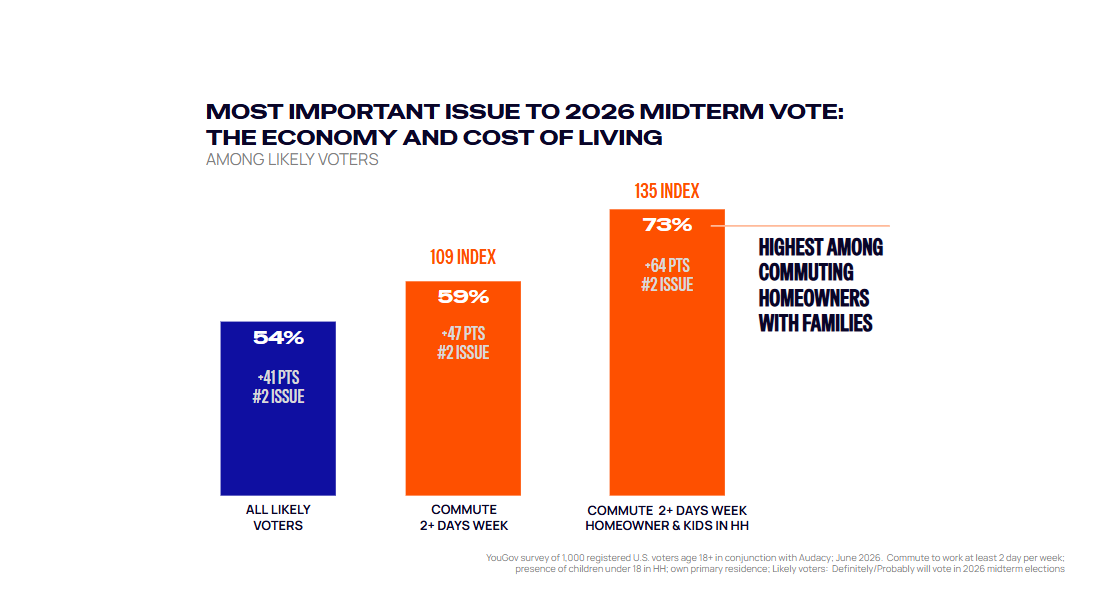
Why? Because commuting acts as an inflation force multiplier. Every trip to work layers unavoidable expenses: gas, tolls, parking, vehicle maintenance, and often childcare, on top of already elevated housing and grocery costs. Unlike discretionary purchases, these expenses can’t simply be eliminated. As inflation persists, commuters are forced to make difficult tradeoffs elsewhere, cutting back on entertainment, streaming subscriptions, dining out, and other nonessential spending sooner and more aggressively than other Americans.
The financial strain is evident across nearly every measure we examined. Among commuters who rank the economy as their top election issue, eight in ten (80%) say their money doesn’t go as far today as it did just one year ago — seven percentage points higher than registered voters overall. For these voters, inflation isn’t an abstract economic statistic. It’s a daily experience they confront every morning before they even arrive at work. The rush-hour voter isn’t simply worried about the economy. They’re living it every day.
The Weekday Commuter is Back
Another big finding from the Audacy/YouGov study is that the American commute has returned, with most working Americans traveling to their jobs on a regular basis.
Among Americans employed full or part time, 78% say they commute to work at least two days a week, while nearly three-quarters (73%) commute three or more days each week. Even more striking, 45% report commuting all five days of the traditional workweek.
This is consistent with what is being reported elsewhere. According to Placer.ai, nationwide office attendance reached a post-pandemic high in June, rising 9% year over year and climbing to nearly 80% of pre-pandemic levels. MRI/Simmons likewise estimates that 66 million Americans are commuting in 2026 — the largest commuting workforce of the post-pandemic era.
Why Political Campaigns Should Prioritize Radio & Podcasts This Fall
Radio and podcasts are uniquely positioned to help political campaigns reach the voters who are most engaged in the issues driving this year’s election.
Here’s why:
Radio & podcasts dominate the daily commute
Nearly 90% of American workers commute by car, and AM/FM radio and podcasts account for the vast majority of ad-supported in-car listening.
Economic concerns are even more pronounced among radio & podcast listeners
While the economy dominates this election, the crisis is more amplified among radio and podcast listeners.
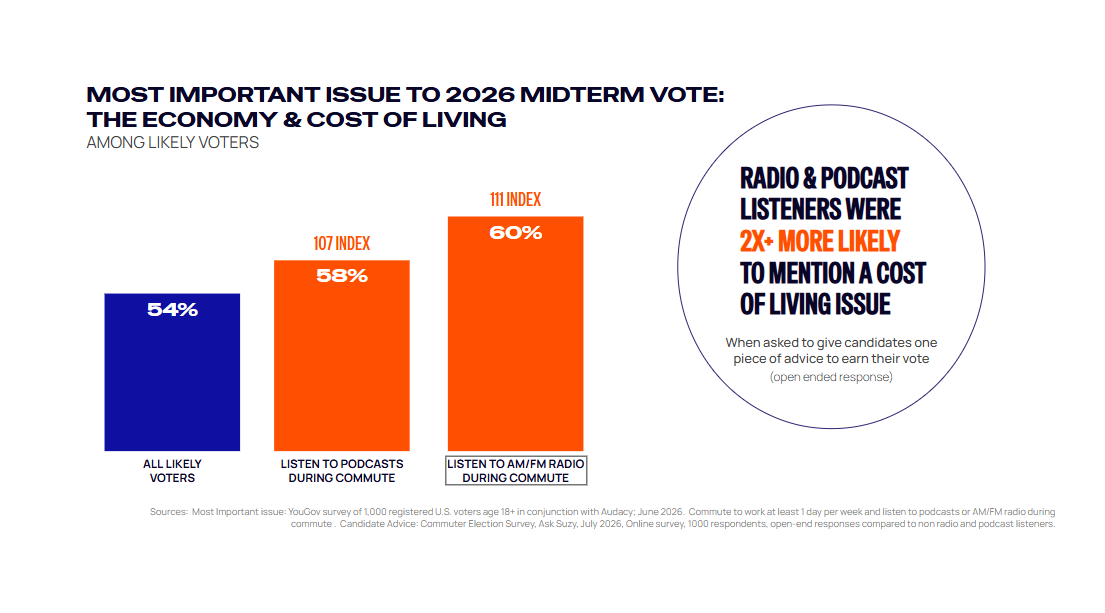
These listeners are more likely to rank the economy as their top voting issue and are more than twice as likely to cite the cost of living when asked what candidates should address to earn their vote.
They are also more likely to report feeling tired of “politics as usual” and are more willing to cross party lines for the right candidate who can make a difference in their lives.
Haley Tear-Lombardo, VP of Government and Political Partnerships at Audacy explains, “It’s easy to look at elections through the lens of data, but the story of 2026 is really being written on the highway. We’re seeing a shift in how voters consume political information. The daily commute is no longer just travel time; it’s one of the most important moments for reaching voters. Audio fits seamlessly into that routine, giving campaigns a trusted, uncluttered environment to speak to the economic concerns driving voter motivation this year—at a moment when people are most likely to listen.”
Radio & Podcast Listeners Are Going to Turn Out and Vote
Radio and podcast listeners are more engaged politically than the general electorate this year. Compared with all registered U.S. voters, they are more likely to say they will definitely vote this fall and more likely to qualify as likely voters.
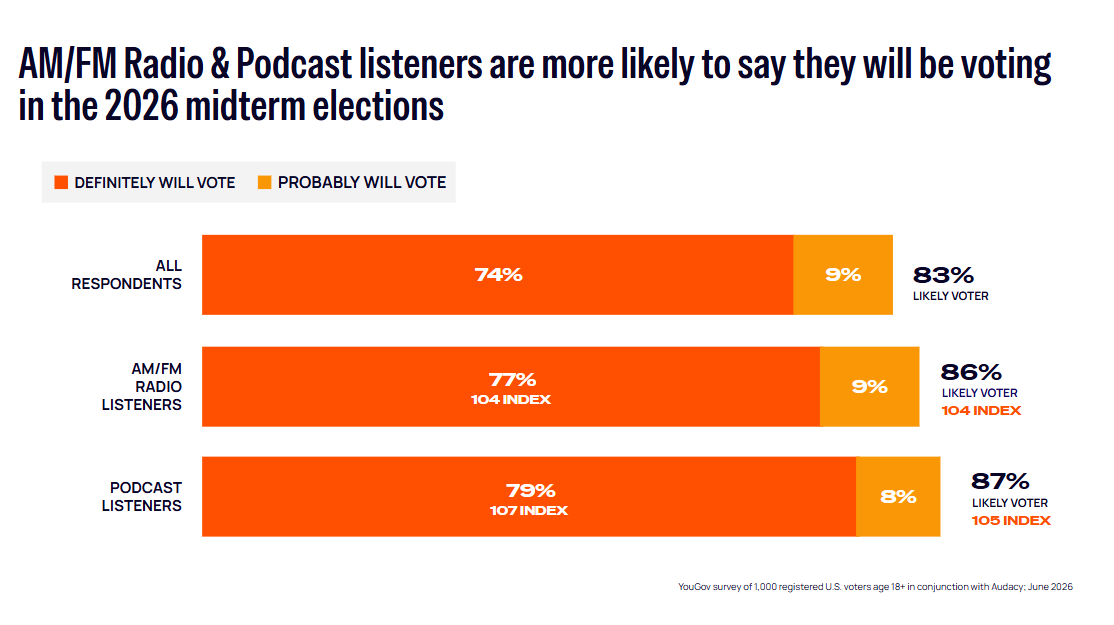
Radio has always excelled at delivering reliable voters, even in non-Presidential election years. According to Nielsen Scarborough, radio reaches more people who say they ‘always vote’ in local and statewide elections than linear television and more than every major streaming/CTV platform including Amazon Prime, YouTube and Netflix.
Trusted Media Environments Make Every Campaign Dollar Work Harder
Audio platforms are among the most trusted media platforms and are deeply embedded in the daily lives of engaged voters. That means campaign messages are more likely to be heard, believed, and remembered by the audiences campaigns are trying to influence.
By comparison, social media platforms are viewed as less trustworthy and are more likely to expose campaign advertising to people who rarely or never vote.
Audio Can Be The Difference Between Winning & Losing an Election
Want proof?
Take a look at two Nielsen case studies from the 2022 midterms:
U.S. Senate Election in Pennsylvania
John Fetterman spent 6X more on television (linear, cable, CTV) than on radio in Pittsburgh and Philadelphia. But his decision to allocate 14% of his media budget to radio gave him a significant advantage. Radio extended his TV reach by 10% and 676,000 more unique voters; and he won the race by just 263,752 votes.
U.S. Senate Election Runoff in Georgia
Raphael Warnock spent 3X more on television (linear, cable, CTV) than on radio in Atlanta. But his decision to allocate 24% of his media budget to radio may have been the difference in the race. Radio extended his TV reach by 18% and 659,000 more unique voters – and he won the race by just 96,613 votes.
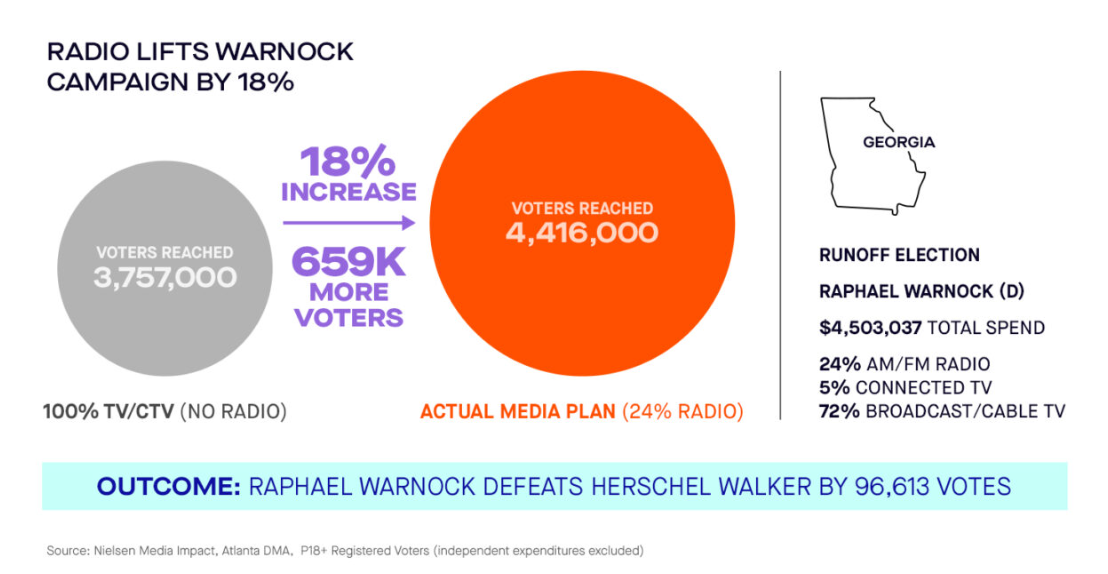
These successful campaigns from the 2022 midterms demonstrate that integrating audio into the media mix is not just an alternative strategy; it can very well be a decisive one.
Why Audio Owns the Defining Moment of the 2026 Midterms
The 2026 midterm elections are being shaped by a singular, powerful voter: the commuter.
These Americans are living the cost-of-living crisis every day, making them among the most economically anxious and politically motivated voters in this election.
Audio delivers a double advantage that few other media can match. First, radio and podcasts dominate the daily commute, allowing campaigns to reach millions of voters during one of the most consistent and attentive moments of their day. Second, radio and podcast listeners are even more likely than voters overall to rank the economy as their top election issue, and are more likely to turn out and vote.
In other words, audio doesn’t simply reach commuters, it reaches the very voters most motivated by the issue that will define this election. And it does so in trusted media environments where campaign messages are more likely to be heard, believed, and remembered.
Every election has a defining voter, a defining issue, and a defining medium. In 2026, those three will converge. The defining voter is the commuter. The defining issue is the economy. And the defining medium is audio. Campaigns that recognize that intersection will be best positioned to influence the voters who ultimately decide the outcome.
Want to talk more about reaching your target audience?
Let´s TalkRelated Insights
Related Insights
Ready to Make Audio Work for Your Brand?
ADVERTISE WITH US